
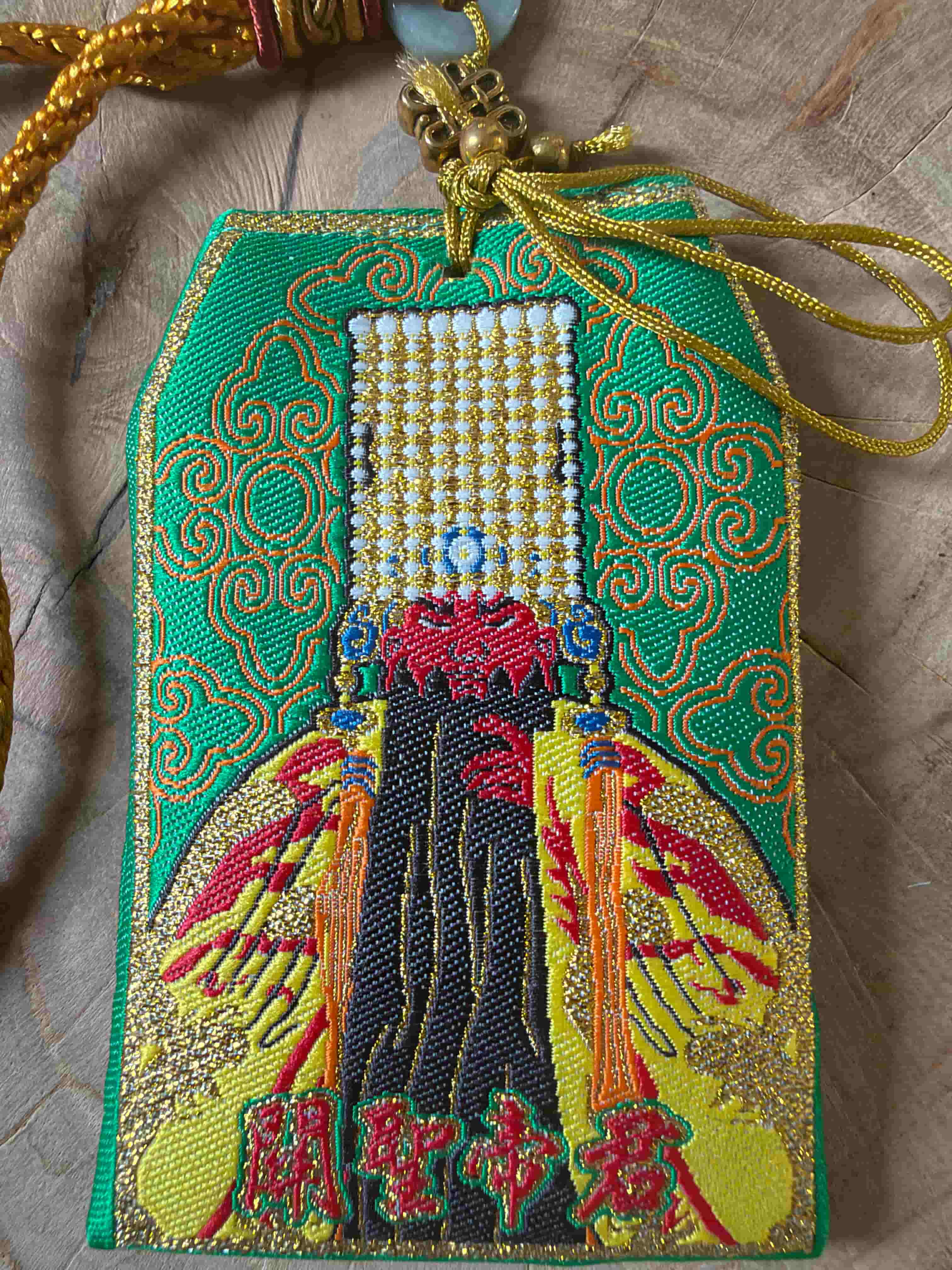
横浜 中華街にある関帝廟のお守りです。
三国志で有名な武神 関羽様が祀られているそうです⚔️
吉川英治さんの三国志を何度も読み返しているわたくしとしては感無量です😭
劉備、孔明、関羽、張飛、趙雲、馬超、黄忠💪
官渡の戦い、夷陵の戦い、赤壁の戦い、、、そして五丈原🔥
三国志、また読みます📕
An amulet from the Kanteibyo Temple in Yokohama Chinatown!
It enshrines Guan Yu, the legendary God of War from Romance of the Three Kingdoms ⚔️
As someone who has re-read Eiji Yoshikawa’s “Romance of the Three Kingdoms” countless times, I am overwhelmed with emotion 😭
Liu Bei, Zhuge Liang, Guan Yu, Zhang Fei, Zhao Yun, Ma Chao, Huang Zhong 💪
The Battle of Guandu, the Battle of Yiling, the Battle of Red Cliffs… and Wuzhang Plains 🔥
Guess it’s time to re-read the Three Kingdoms again 📕
About Kuan Ti Miao
The current structure of Kuan Ti Miao in Yokohama Chinatown was inaugurated on August 14th, 1990 and is the fourth rebuild of the temple. The original temple was built in 1871 but destroyed in the Great Kanto Earthquake of 1923. The second reconstruction was ruined in an air raid during WW2 in 1945, and the third was lost due to a fire of unknown origins in 1986.
Many of its components and craftsman hailing from China. The dragon marble slabs shipped from Beijing that flank the entryway from the main road to the temple were each carved from one continuous piece of marble weighing 4.5 tons. The colorful dragon cornices that adorn the tops of the temple gates and roofs where crafted in Taiwan and carefully shipped to Yokohama as were the four ornate pillars that root in front of the inner temple entrance.
About Guan Yu
It is said that Guan Yu was born in the Changping Village of Xieliang-xian in Hedong (presently Xie-xian of Shanxi Province) in 160 A.D. on June 24th according to the lunar calendar. He started studying The I-Ching (Book of Changes) and The Chunqiu (Spring and Autumn Annals) under the tutelage of his grandfather Shipan at an early age and is said to have kept these books close with him at all times.
At the age of 18, Guan Yu inadvertently killed a member from a ruling family and exiled himself to Chou-xian. During his exile, he met fellow warriors Liu Bei and Zhang Fei with whom he forged deep bonds and took an oath of solidarity in brotherhood. The three warriors agreed to establish Liu Bei as the eldest, Guan Yu as the second and Zhang Fei the youngest. In the Garden of Peach Blossoms, they made a commitment to stabilize and serve the country to their last breath.
After the fall of the Later Han Dynasty, the three warriors aspired to establish the Shu Empire and enthrone Liu Bei. With the dedicated support from Guan Yu and Zhang Fei, Liu Bei became the emperor and solidified a strong foundation in the Shu Empire.
Guan Yu was captured and executed along with Guan Ping by the allied forces of Cao Cao and Sun Quan in 219 A.D. at the age of 58. The Shu Empire and Liu Bei family built a temple in recognition and gratitude for Guan Yu’s loyalty and contributions, and many later dynasties followed suit.
Aside from being a skilled military general, Guan Yu was the inventor of the accounting method prevalent in ancient China. Merchants and business people in China deeply valued the acumen and integrity exhibited by Guan Yu in his commitments. The General was also a staunch ally to vulnerable populace and came to be worshipped as Lord Guan. Thousands of temples were established throughout China and around the world. Today, Guan Yu is commonly worshipped to bring business success and financial prosperity.


From Japan.
— WabiSabi Asobee
No comments yet.